

1. Introduction:
I wonder if there are many people like me, who have been constantly pondering what they really are for a very long time — especially as a child. Whenever night fell and I was trying to fall asleep, my mind would start racing; I was always filled with curiosity about myself, feeling that I was an indescribable entity existing within my own mind — capable of thought and emotion. At the time, I came to believe that this was a question that ought not to exist, so I began telling myself repeatedly to focus on living in the present and to stop thinking about such matters.
It was only recently, on a whim, that I decided to revisit this question. Drawing on my own hypotheses, I resolved to attempt a visual representation of consciousness, thereby giving myself the space to reflect further and arrive at a provisional answer to this question.
2. Rethinking:
At this point, it is worth mentioning a concept: what we are about to explore concerns the abstract nature of self-awareness in humans — and indeed, in all living beings; in other words, what is the true core that governs our behaviour and thoughts. Therefore, at this stage, we must set aside the constraints of physical thought. Since consciousness resides in the brain, from a physical standpoint, the brain is the self; our limbs and organ systems all serve the brain to carry out the commands it issues. We may therefore boldly imagine that, provided the brain remains active and healthy, the failure of the body and its organs does not necessarily lead directly to the organism’s demise. Does this imply, then, that apart from one’s core self, all other components are replaceable or repairable? Of course, it cannot be denied that one’s physical body is a gift of life, unique and an integral part of oneself.
Regarding the relationship between the brain and the body, in line with our understanding of objective reality, any external stimulus or behavioural command in the brain is transmitted via electrical signals through a number of neurons. Here, neurons effectively function as ‘channels’; it can therefore be understood that, whilst electrical signals are being transmitted through these neural channels, the process of self-awareness and the issuance of commands have already taken place. So what influences us, or rather, what determines the formation of our self-awareness in this process? I would venture to suggest that these channels constitute the very essence of our consciousness; all external information, passing through these neuronal channels, can be transformed into behaviour characterised by self-aware judgement. It could also be said that this is our true, non-concrete essence, whilst the nature of the content within these channels represents the next dimension we must continue to explore.
3. Hypothesis:
Firstly, I shall conceptualise self-awareness as a visualised channel, serving as a conduit for the transmission of neural electrical signals. Viewed in this light, if the channel constitutes the essence of individual consciousness, where exactly do the differences between living beings lie? This depends on another component of the channel: memory fragments — that is, the residual traces of memories generated through our experiences. The channel, as the essence of consciousness, serves as a repository for memory fragments. As external information is received, we make judgements based on the memory fragments accumulated to that moment, thereby generating subjective consciousness and issuing behavioural instructions in response to external stimuli. Meanwhile, these memory fragments are continually supplemented and replaced as new external information flows in; ultimately, through this process of constant accumulation and renewal, a gradually maturing sense of self emerges.
Let us illustrate this process of renewal with an example: suppose we receive new, revolutionary information regarding the same event or definition; we will then engage in behaviour that supplements or replaces the relevant memory fragments — which can be simply understood as ‘refreshing’ our worldview regarding that matter. However, when faced with entirely new phenomena, we lack the means to apply subjective judgement; consequently, we appear indifferent, ignorant and curious. At this stage, new memory fragments are formed and stored as residual information as it passes through the channels of consciousness. Yet, when exposed to the same stimulus a second time, we are able to respond and make judgements to a certain extent based on these stored memory fragments. Consequently, to a certain extent, all our subjective decisions and judgements are determined by the residual fragments of memories derived from our past experiences. In other words, the differences and characteristics between living beings may depend on the varying subjective judgements resulting from their distinct experiences. From a materialist perspective and in terms of the dimension of actuality, our essence — that is, our very selves — is the combination of these neural pathways and memory fragments.
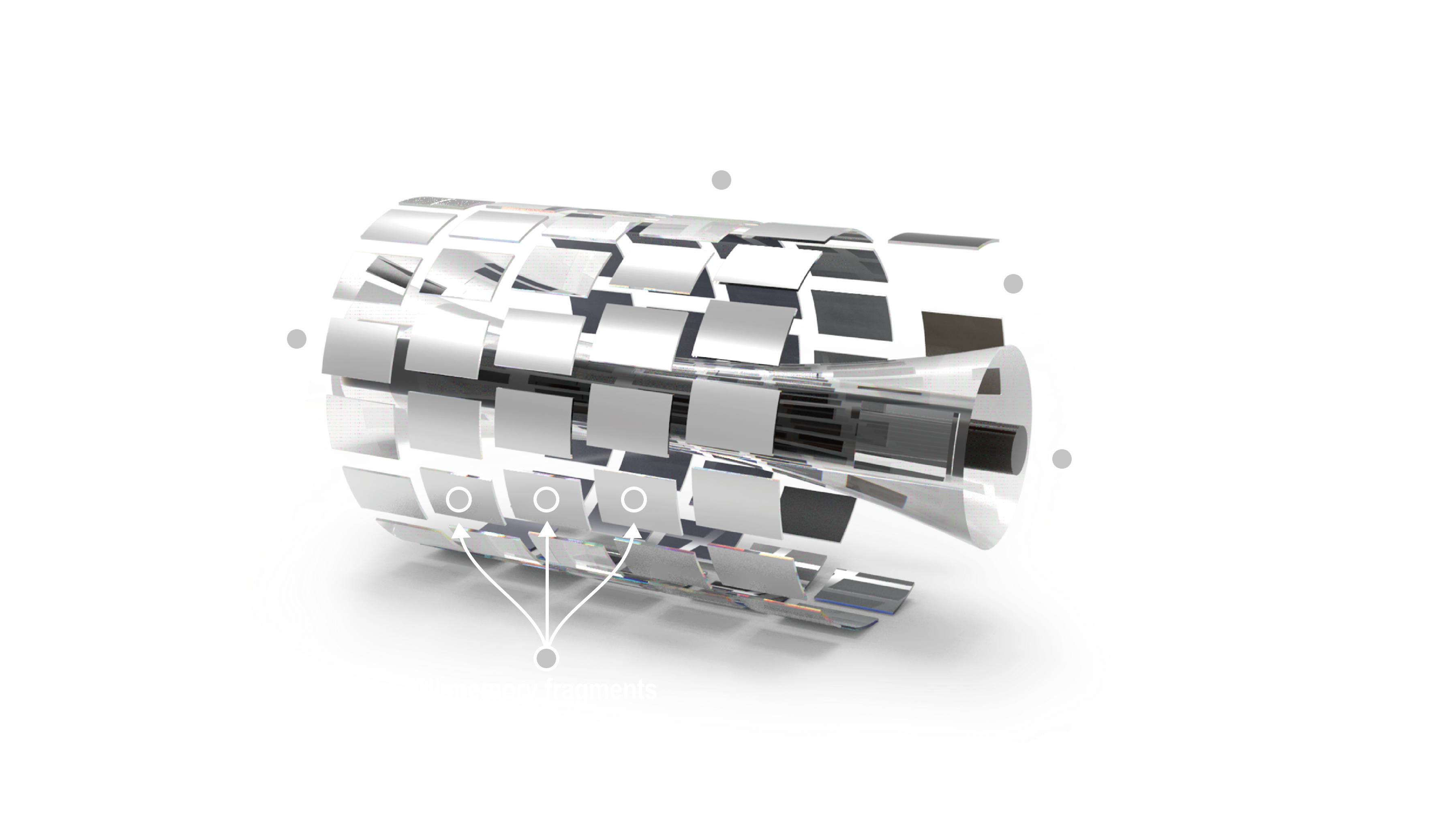 (Original consciousness process model 01)
The whole process of self-awareness is mainly divided into three parts:
(1) The process of subjective judgment
External information is fed into the neural network as electrical signals; under the influence of accumulated memory fragments, it generates self-assessments and behavioural instructions, which serve as the fixed output of the conscious process.
(2) The formation of new memory points
When entirely new phenomena are input as external information, the electrical signals cannot generate expressions of self-awareness through the influence of accumulated memory fragments; in this process, the present experience is deposited as new memory fragments and stored within the neural pathways.
(3) Old memory point renewal process
During the process of continuous electrical signal input regarding the same object, the influence of fixed memory fragments causes the output of self-awareness to become progressively faster and more proficient. However, when different or disruptive electrical signals are input regarding the same object, a process occurs following the output influenced by memory fragments whereby the memory of that object is either supplemented or replaced.
4. Bibliography:
[1] Sigmund Freud (1917), “A general introduction to psychoanalysis.”, Vorlesungen Zur Einführung in Die Psychoanalyse
[2] Mediumship, Psychical research, Dissociation, and The powers of the subconscious mind, Journal of Parapsychology, 78(1), 98–114
*The ownership of the project and the information belongs to the individual only for communication and sharing. Do not copy or use it for commercial purposes.